
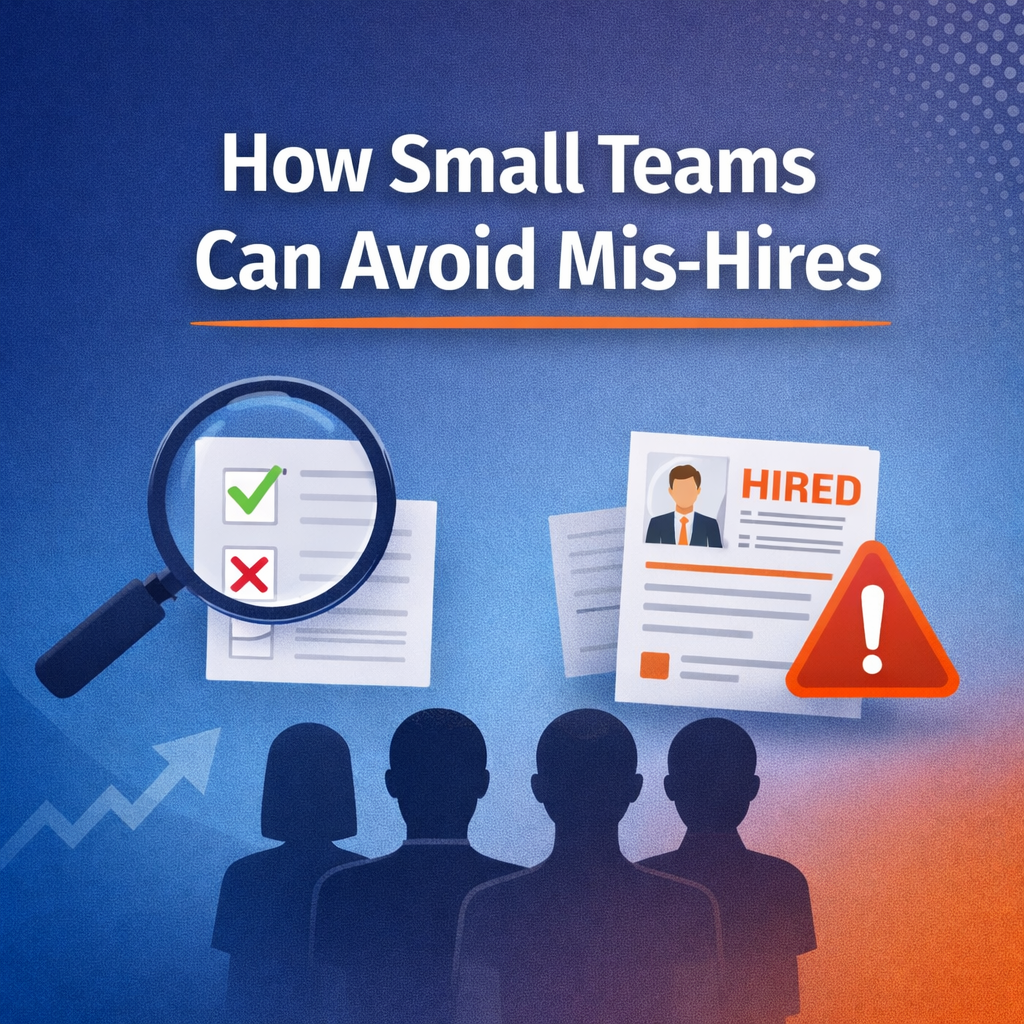
Hiring the wrong person is expensive — not just financially, but operationally, culturally, and emotionally. Small businesses and nonprofits feel this pain more than anyone, because they don’t have extra headcount to absorb mistakes, and hiring decisions are often made without HR infrastructure.
The good news: you can dramatically reduce the risk of a bad hire by improving decision quality and adding structure earlier in the hiring process. You don’t need to become a recruiting expert — you just need a few practical systems.
Below are nine ways small teams can lower hiring risk without adding complexity.
1. Start With Role Clarity (Not Just a Job Title)
Bad hires often start with vague or overly broad role definitions. When hiring managers can’t articulate what success looks like, candidates can’t evaluate fit and interviewers can’t make consistent decisions.
Clarify:
-
primary outcomes the role must achieve
-
who the role supports
-
what skills are non-negotiable
-
what behavioral traits matter most
-
how success will be measured
Clarity reduces misalignment — ambiguity invites risk.
2. Upgrade Job Descriptions From Tasks to Outcomes
Most job descriptions read like task lists. Tasks don’t reduce hiring risk — outcomes do. Good candidates want to know what they will be responsible for and how success will be judged.
Example shift:
Instead of:
“Manage client communications and schedules”
Use:
“Maintain 95% on-time communication for client deliverables, ensuring no more than 2 reschedules per month.”
Outcome-based descriptions attract stronger candidates and filter out misfits early.
3. Use Structured Hiring Screens to Reduce Noise
Small teams tend to go straight from resume → interview, which increases risk because interviews are time-intensive and inconsistent.
Adding lightweight screens reduces noise:
-
short written prompts
-
one-way video interviews
-
work samples
-
scenario questions
These allow you to compare candidates before tying up the team in interviews.
One-way video interviews are especially powerful for roles where communication or responsiveness matters.
4. Evaluate Behavioral Fit — Not Just Skills and Credentials
Skills tell you if someone can do the job.
Behavior tells you how they’ll do it.
Many bad hires happen when the candidate has the skills but not the behavioral alignment to the role or team.
DISC and similar frameworks help teams understand:
-
communication style
-
pace
-
risk tolerance
-
collaboration style
-
response to pressure
Behavioral data doesn’t replace interviews — it improves them.
5. Compare Candidates Consistently (Not by Gut Feel)
Unstructured interviews lead to:
-
inconsistency
-
recency bias
-
“chemistry” bias
-
decision fatigue
-
poor documentation
Structured scoring produces:
-
defensible decisions
-
reduced bias
-
faster debriefs
-
better cross-team alignment
You don’t need 20 criteria. Even 4–6 standardized criteria make a big difference.
6. Check for Work Style and Communication Compatibility
Miscommunication — not incompetence — causes most early failures.
Simple ways to test fit:
-
short writing samples
-
email follow-up instructions
-
scenario questions
-
asynchronous problem solving
-
intake forms for client-facing roles
These are especially important in legal, professional services, finance, and healthcare settings.
GET DISC PROFILES FOR THE MOST COMMON POSITIONS
7. Involve the Right People (But Not Everyone)
Too many interviewers lead to contradictory feedback and slow decisions.
Too few create blind spots.
Best practice for small teams:
-
1 hiring manager
-
1 cross-functional stakeholder (if relevant)
-
1 culture/fit observer (optional)
Avoid interview committees unless the role truly demands it.
8. Shorten Time-to-Decision (Speed Reduces Drop-Off Risk)
A surprising number of bad hires occur because teams lose the good candidate and settle for whoever’s left.
Reducing cycle time lowers risk. Examples:
-
pre-stocked questions
-
scheduled interview blocks
-
one-way video screens
-
faster internal debriefs
Good candidates don’t stay unclaimed for long — even in soft markets.
9. Onboard With Intent
Bad hires can become good hires with the right onboarding.
Onboarding should:
-
clarify priorities
-
define outputs
-
establish communication norms
-
set expectations for ramp timelines
-
check in weekly for the first 30–60 days
Risk reduction doesn’t stop once the offer is signed.
So Where Does HiringSteps.com Fit?
HiringSteps.com helps small teams reduce bad-hire risk by adding light structure without adding HR overhead. Specifically:
✔ Good Job Descriptions (with outcomes)
✔ Behavioral Benchmarks (DISC)
✔ One-Way Video Screening
✔ Centralized Evaluation & Scoring
✔ Faster & More Confident Hiring Decisions
But even if you never use HiringSteps.com, the principles above will reduce your risk.
If you want to quantify what a mis-hire could cost your organization, our Cost of a Bad Hire Calculator will be live shortly.
And if you want to explore structured ways to reduce hiring risk, HiringSteps.com can help.