
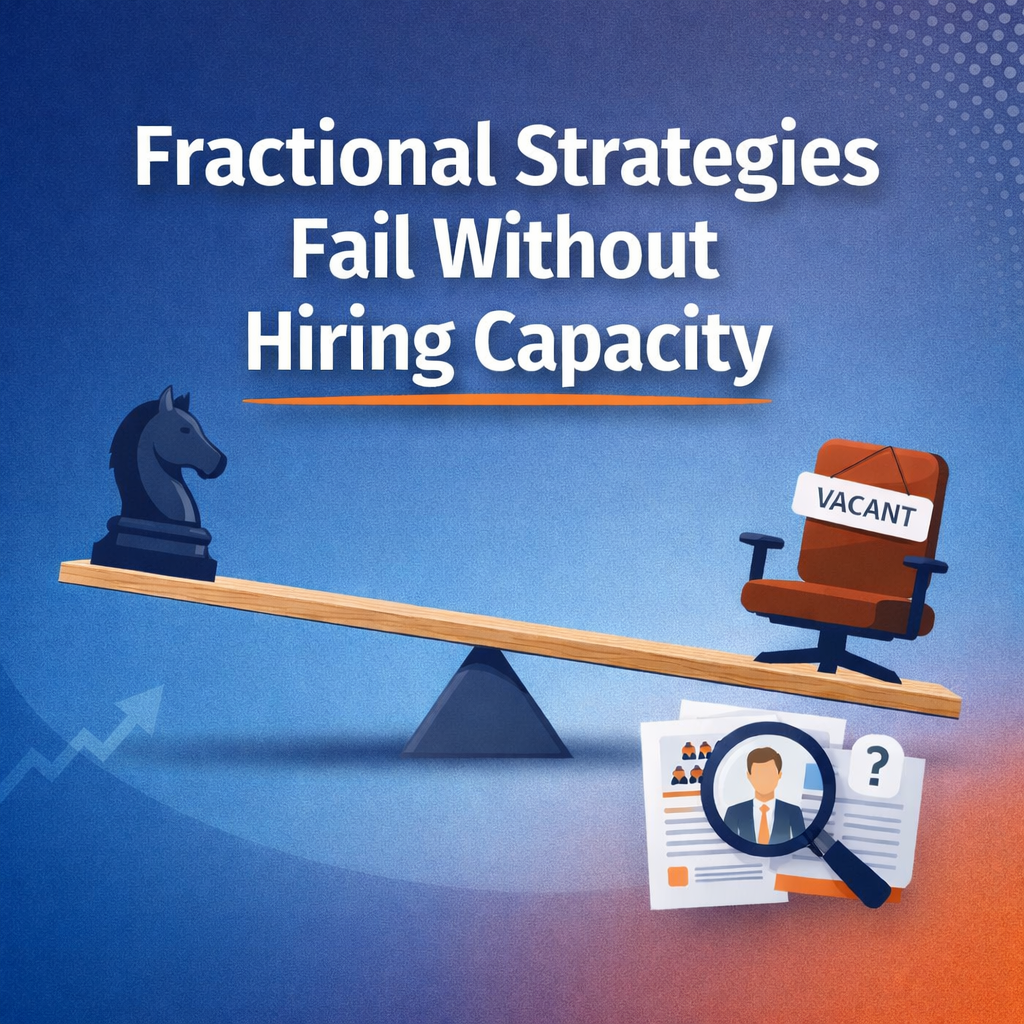
Fractional executives are brought in to accelerate progress. Whether the remit is revenue, operations, finance, marketing, or strategy, the expectation is clear: move the client forward faster than they could on their own.
But across dozens of engagements, one pattern keeps emerging:
Fractionals can build the plan, but they can’t execute the plan if the client can’t hire.
This bottleneck shows up in predictable ways:
• No capacity to implement the strategy
• Owner or founder overload
• Missed deadlines due to staffing gaps
• Burnout for the existing team
• Deferred initiatives, launches, or campaigns
• High-dependency on contractors when FTEs are needed
In other words: client execution capacity becomes the limiting factor.
Why This Matters More in SMB Environments
Large companies have HR departments, recruiting pipelines, onboarding playbooks, and structured hiring processes.
Most SMB clients do not.
Hiring instead lands on:
• the founder
• the operations lead
• the office manager
• or “whoever has time”
This creates an invisible drag on fractional work. What looks like “strategy failure” is often “capacity failure.”
Fractionals Solve Strategic Problems. Hiring Solves Execution Problems.
Fractional leaders excel at:
diagnosing what needs to change
building plans
prioritizing
sequencing
structuring
reporting
enabling
But execution requires people, and hiring is often the most neglected operational competency in SMBs.
Clients struggle with:
• unclear role definitions
• vague expectations
• chaotic recruiting
• unstructured interviews
• gut-driven decisions
• slow onboarding
Fractionals end up firefighting symptoms that trace back to a single root cause: the client can’t reliably put the right people in the right seats.
Tired of hiring issues impacting your engagements?
Fractionals Are Starting to Add Hiring Enablement to Their Scope
The smartest fractional operators are adapting. They aren’t trying to replace HR departments — they’re giving clients the minimum viable structure to hire without one.
This typically includes:
• defining roles in terms of outcomes
• clarifying what “success” looks like
• adding behavioral insight (DISC)
• reducing interview load
• creating consistent evaluation frameworks
• making decisions faster and with less risk
This isn’t “HR.”
It’s strategic enablement.
Where HiringSteps Supports Fractional Work
HiringSteps was built for clients who:
• don’t have HR
• hire infrequently
• can’t afford mis-fits
• need relief and confidence, not another ATS
Fractionals use HiringSteps to:
• define roles clearly
• benchmark behavioral fit
• streamline candidate screening (one-way video)
• centralize evaluations
• reduce founder chaos
• increase execution speed
The result? Fractionals get to finish what they were hired to start.
The Takeaway
Fractional work breaks when clients can’t hire.
HiringSteps gives fractionals the scaffolding to fix that — without turning them into HR departments.